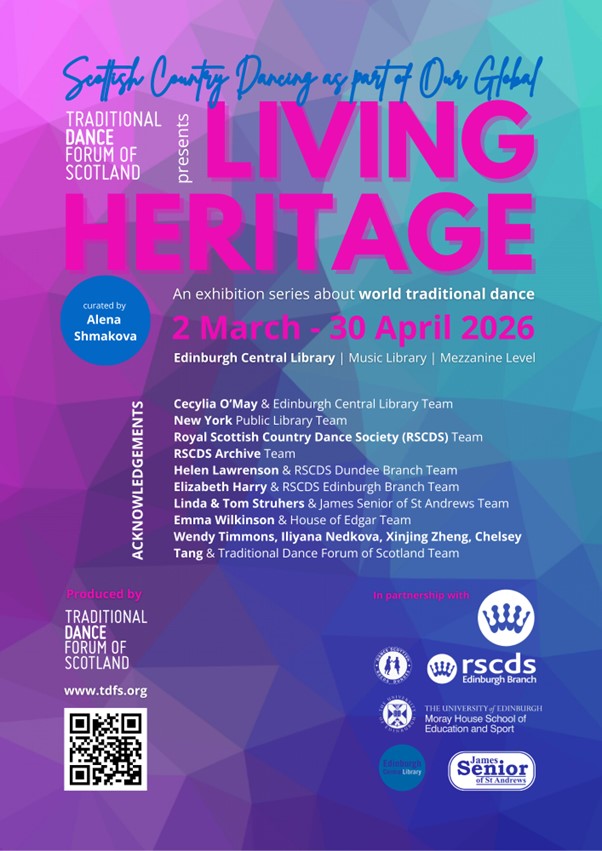
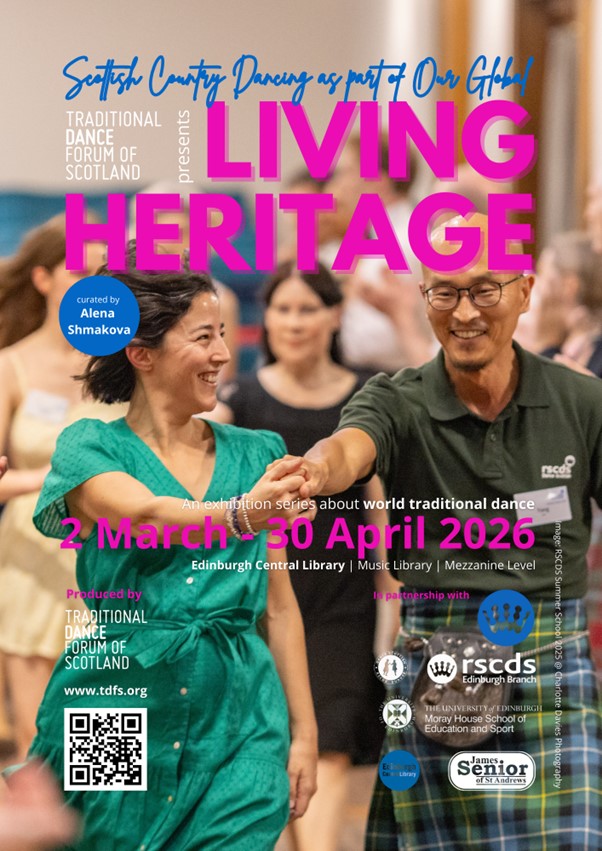
Celebrating women’s history with Living Heritage – an exhibition at Central Library until 30 April 2026, curated by the Traditional Dance Forum Scotland in partnership with the Royal Scottish Country Dance Society
by Alena Shmakova
More than a dance
At first glance, this exhibition tells the story of the Royal Scottish Country Dance Society (RSCDS), how Scottish country dancing emerged as a national style and connected to broader heritage traditions. But look closer. Look at the faces in the photographs and the handwriting in the notebooks. You will see not just steps and formations, but people. And many of those people are women.
Founded in 1923, the RSCDS emerged from the shadow of the First World War, a period of profound loss and social upheaval. A generation of young men had been lost, leaving thousands of women to navigate a world that offered them few places. It was into this breach that a small group of formidable Scottish women stepped. They were physical education pioneers, aristocratic visionaries, musicians and keen dancers. Of course, they were not alone. The first meeting books of the Society list many names, both women and men. But as this exhibition was set up for a run during Women’s History Month and beyond, it felt right to focus on the women for this particular display.
This exhibition is thus a spotlight on the women who contributed greatly to the development of the dance style and the Society – not merely preserving Scottish country dancing but resurrecting it. They took a tradition that was fading from popular culture and made it a global phenomenon. In the words of Society’s co-founder Jean Milligan, they “resuscitated an ailing patient”.
A note on time and omission
We are acutely aware that many more women deserve recognition than we were able to spotlight in the Living Heritage exhibition at Edinburgh’s Central Library. Indeed, every branch of the RSCDS around the world could nominate at least one important woman from their own local history. We regret that we could not include them all here. As a short addendum, we wish to acknowledge two long-serving RSCDS Secretaries whose daily labour held the Society together for decades: Muriel Hadden (1942 to 1967) and Muriel Gibson (1975 to 1988). The latter felt especially relevant as she started the collection which is now preserved and known as the RSCDS Archive. Their names belong in this exhibition, even if space and time have not allowed their full stories. We hope this exhibition is therefore a beginning, not a conclusion. There is also a story to be told about the male dancers, one we hope to turn to in the future.
The founders – the visionaries of 1923
Jean Milligan and Ysobel Stewart
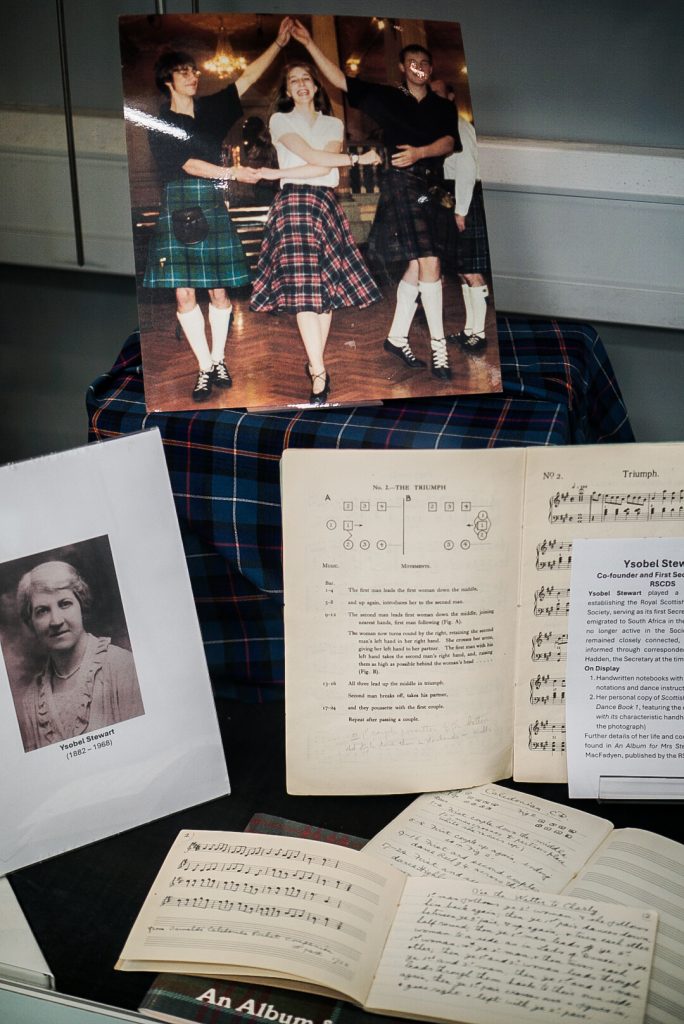
Every great institution has its origin myth. For the RSCDS, it usually begins with a meeting arranged by music publisher Michael Diack in Glasgow, where Mrs. Ysobel Stewart of Fasnacloich met Miss Jean Milligan.
Ysobel Stewart brought the memory. In England, Cecil Sharp was pioneering revivals of English country dances from old manuscripts, but in Scotland these dances had never fully vanished and Stewart knew them first-hand due to her background. She had grown up dancing the old country dances and hearing the reels at traditional gatherings. As the Girl Guide Commissioner for Argyll, she was determined that Scottish Guides should know their own dances, not just those from south of the border.
Jean Milligan brought the discipline. A lecturer in Physical Education at Jordanhill College, Milligan was a product of the radical physical education movement sweeping through Britain. Trained in the famed Bergman-Österberg system at Dartford College, a hotbed for female physical training, she viewed dance not as recreation, but as a science of healing and coordination. Where Stewart saw heritage, Milligan saw health benefits and pedagogy. Together, they developed the style known today as the RSCDS style. They published the first “Book of Dances” in 1924, meticulously standardizing formations, figures, and steps that had previously been passed down in chaotic variations.
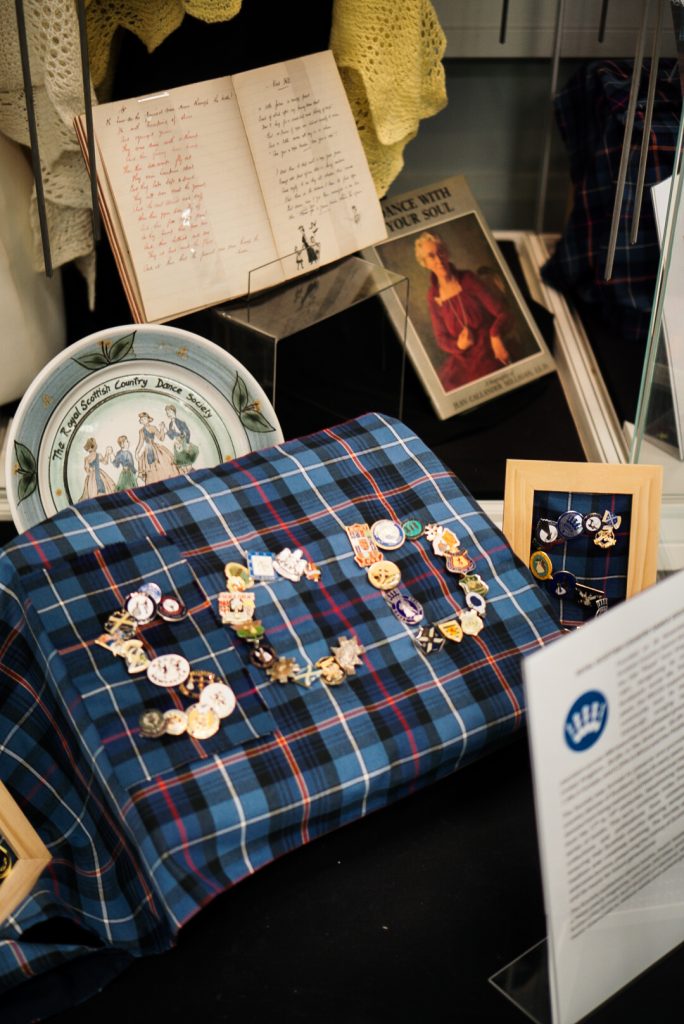
However, in addition to the dance-related stories, we also wanted to highlight other sides of these women. The RSCDS Archive keeps a notebook of Jean Milligan’s poetry with tiny sketches – quiet, observant verses that reveal a reflective soul behind the rigorous teacher and public figurehead. She was also an avid knitter. Her needles moved in rhythm, perhaps not unlike the patterns of a strathspey. She was a woman of many crafts. Dance was only the most public one.
The trailblazers – breaking barriers
Annie Scott Shand: the musician
You cannot dance without music, and when it comes to country dancing, nobody argues that Scottish tunes are fundamental to creating the national style. Even today, you see people dancing while quietly murmuring verses of famous Scottish songs.
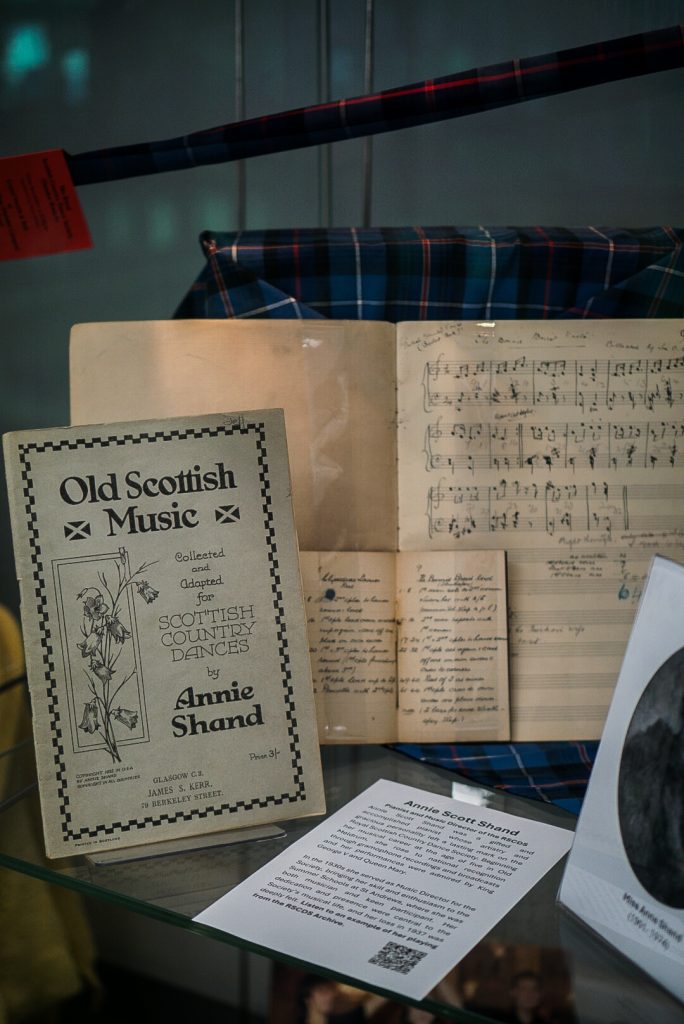
Annie Scott Shand was a virtuoso pianist and composer who brought fiddle tunes to the keyboard. Her work helped codify the musical timing of the dances, moving them from the village hall to the dance studio.
There is another layer to her story. Keyboards have historically been considered a more female-oriented instrument. In the early 20th century, major ballet companies also began substituting piano for violin, making music accompaniment a possible female occupation – a shift that opened doors for women like Shand.
Lady Dorothea Ruggles-Brise: patroness and music scholar
While Milligan and Stewart worked the floor, Lady Dorothea Ruggles-Brise was instrumental in the selection of music, often consulting the Society’s Research Committee on musical matters. She was a serious scholar of Scottish musical tradition, following a long tradition of female Lady Patronesses supporting Scottish social dancing.
Her extensive collection of books on Scottish music, gathered over a lifetime of passion, was donated to the AK Bell Library in Perth, where it remains available for all to consult and is known today as the Atholl Collection. She believed that knowledge should be open. The RSCDS Archive is also fortunate to hold several rare books from her collection, published in Scotland in the 18th and 19th centuries.
The Atholl Collection, and those books, are her living legacy. We wish more documentation of her work with the Research Committee had survived. Music library collections associated with female figures are rare. Most collections in the field of Scottish music, especially those of significant size, were gathered by men. Lady Dorothea’s collection stands out as a notable exception. It represents a moment when women were beginning to shift from being connoisseurs of music, appreciators of the art, to being experts whose knowledge shaped the field.
Shaping the Society
Meta Dow, Allie Anderson and Mary Isdale MacNab
While the founders set the vision, it was women like Meta Dow, Allie Anderson, and Mary Isdale MacNab who carried Scottish country dancing across the country and beyond.
Meta Dow was a major force in the early revival. Trained in physical education, she became head of women’s PE at Dundee Training College and helped establish the Dundee Branch in 1925, becoming one of its first teachers. She taught regularly, organised schools and earned a reputation as the “Miss Milligan of the East”. Apart from being a dancer and teacher, she was also a gifted watercolour artist.
Allie Anderson was a Shetland-born dancer and teacher who shaped Scottish country dancing in Edinburgh for more than six decades. She founded the Edinburgh Branch in 1924, trained generations of dancers, and led renowned demonstration teams, including the group featured in Scotland’s first television broadcast in 1952. Known for her exacting standards, sharp insight and deep commitment to young dancers, she helped define the “Edinburgh style” and left a legacy still felt in classes and performances today.
Mary Isdale MacNab was a prolific dance scholar who took Scottish dance traditions to Canada, where she taught and inspired new generations of the wider Scottish diaspora. She was active not only in promoting Scottish country dancing but also Highland dancing, understanding their common roots. Her research and choreography shaped iconic dances, and her papers remain a vital resource for dancers today.
All three were more than teachers. They were dance scholars, dedicated to researching the history of Scottish dance, preserving old forms and creating new ones. Their work as collectors, archivists and choreographers laid the groundwork for the RSCDS teaching method, a living heritage legacy that continues in every branch today.
Looking forward: guardians of the legacy
This exhibition draws mainly on items from the RSCDS Archive. But archives do not appear by magic. They are built by passionate people who, with time, may be called visionaries. They are not always founders, but they are guardiansm, and here we would like to honour the guardians as much as the pioneers.
Rosemary Coupe
We are delighted to announce a recent RSCDS Archive acquisition: the papers of Rosemary Coupe, formerly of the Vancouver Branch (Canada). Although we received her papers following her passing, through her research notes and gathered dance resources, her voice remains alive, along with the articles she published. As a librarian, she understood that if the Society’s history was not systematically collected, it would be lost: scattered in attics, forgotten in branch cupboards, thrown away by those who did not know its value.
Helen Lawrenson
Meta Dow’s legacy in Dundee is carried forward today by Helen Lawrenson, archivist of the Dundee Branch. Lawrenson wrote ‘Petronella to Prince of Wales’, tracing the history of the RSCDS in Dundee, and contributed to the publication ‘100 Years of Scottish Country Dancing in Dundee’. Through her archival work and writing, she ensures that the branch’s story, and the women who built it, are preserved for future generations.
Elizabeth Harry
Elizabeth Harry, current Treasurer of the RSCDS Edinburgh Branch, is a true treasure of the organisation. A qualified RSCDS teacher and tutor, she has led teacher training courses and remains deeply committed to nurturing the next generation of dancers. As an archivist, she has played a crucial role in preserving the branch’s history, drawing on materials such as the personal photograph album of branch founder Allie Anderson to connect past and present. Her passion for sharing that history was evident when she mounted an exhibition exploring the branch’s archives at RSCDS Headquarters, bringing together members old and new to celebrate their shared heritage.
Beyond her archival work, Elizabeth is also an accomplished choreographer. Her dance ‘Perpetua’ was featured in the Edinburgh Branch’s centenary celebrations, set to a strathspey tune composed in her honour. She has also been a voice for the Society in the wider world, appearing on BBC Radio Scotland to speak about the RSCDS and its traditions.
Her dedication to preserving and celebrating the branch’s story makes her a fitting successor to the legacy of Allie Anderson – and a vital link between the Edinburgh Branch’s past and its future.
The invitation – every branch has her name
If you are able to visit the Living Heritage exhibition, or are simply reading this short article, we invite you to listen to the crackle of the 1930s recording of The Bonnie Breast Knot, played by Annie Shand.
Hear the spirit? That is the sound of survival. That is the sound of women clapping back against despair with rhythm and grace.
But we also invite you to do something else. Every branch of the RSCDS around the world could name at least one important woman from their own history: a teacher who kept the branch alive during a difficult year, a musician who played until her fingers ached, a secretary who never missed a meeting for thirty years. This exhibition cannot name them all. But you can. When you return to your branch, start a list. Nominate her. Write her story down.
The Royal Scottish Country Dance Society is more than steps in a book. It is a living reminder of the women who believed that a reel could lift the spirit and that a nation’s traditions could be kept alive one dance at a time.
Traditional Dance Forum Scotland and the Royal Scottish Country Dance Society (RSCDS)extend their thanks to the RSCDS Archive team and to Honorary Archivist Alan Macpherson for his advice on the figures featured in this exhibition, along with all those who contributed their time and knowledge to make this exhibition possible.